Showing posts with label Europe. Show all posts

Taking Pictures

Wednesday, October 11, 2006


I also wanted to let you all know that I have been taking pictures around Florence, and in the different places I've been. There is a link to "my photos" in the left sidebar if you want to see them. I've just added some of here in Scandicci and a large album of pictures I've taken wandering around the city of Florence. I'll try to mention in my posts when I update my pictures... I would like to post more pictures on here, but it tends to be cranky.

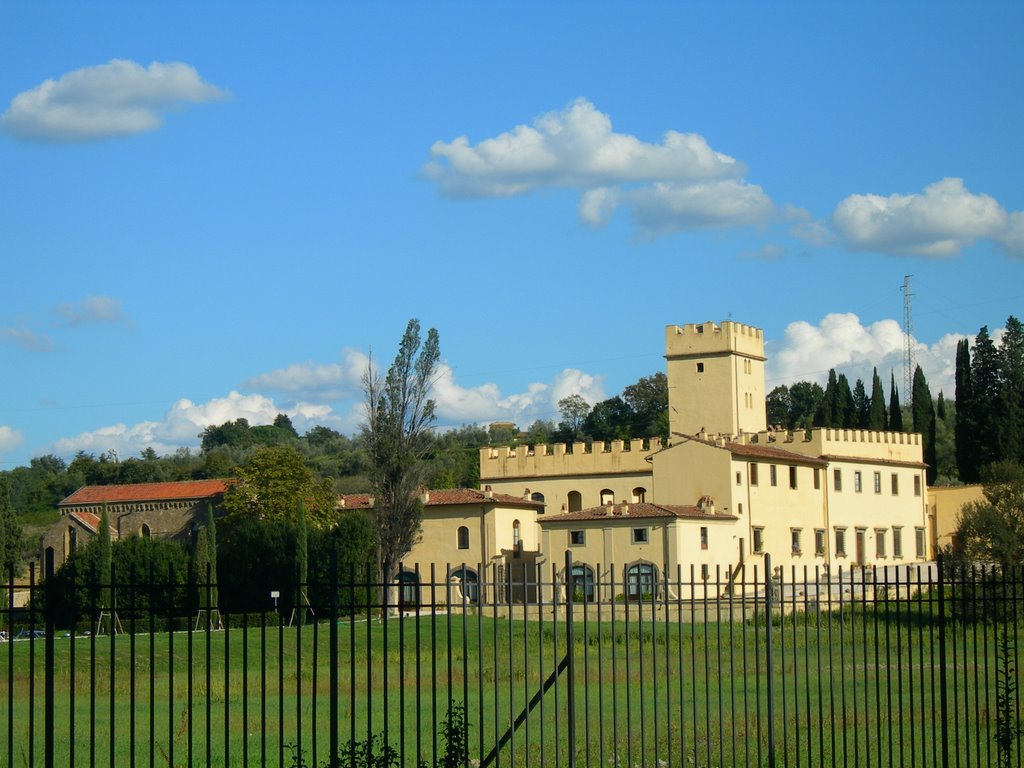
Hey, it worked for once!!! This picture is of a castle ( know when you think of a castle, you think of massive gray stones and high turrets, but this is one of the Italian versions) that is just across the park from the Bible School. It is called Torre Galli, which means the tower of the Galli family.

Language School and exploring the city

Hello everyone! Sorry it's been so long since I've posted. Nothing much of general interest has been going on, and I was sick all last week. I didn't figure anyone wanted to hear me complain. :)

Anyhow, I'm now in week two at the language program at the University of Florence. We aren't going as quickly as we did in the other school, but much more in depth. In the morning from 8:45 to 11:15, we have class. My teacher's name is Irene Zaccone. We have been doing a lot with learning to use prepositions correctly this week, as well as learning vocabulary. From 11:30 to 1:00 everyday, there is a lecture in Italian on various topics--Italin history, art history, Italian literature, Italian food, etc. It's a good chance to listen to the language. Some of the lectures I still can't make much sense of, but in some (the literature one is my favorite, of course! Having studied literature as part of my English major, that topic is easier to understand) I can follow the lecture and get most of the lesson, even if I can't understand every detail.

I'm beginning to see a difference at church in Bible class, too. For the first few weeks, I was just sitting through the lessons, but now I am catching the scripture references and understanding the major points. This past Sunday, Giovanni talked about Jesus in the garden of Gethsemane, and next week will will study His trial before the Sanhedrin. I have an Italian Bible, and I am learning to follow along. I still have a long way to go, but I am beginning to see progress.

I'm also enjoying meeting the other students in my class, as we will be spending the next two months together...There are a few Americans; I have become friends with a girl from Oregon, Cheryl, and her French husband. We usually sit together in the lectures. There are quite a few Japanese students, too. One, Shihoko, speaks very good English. Her husband is a chef who is working in Italy for a few months, so she is trying to learn some Italian while she is here. The others seem very nice, but they speak no English. It is definitely a good incentive to learn Italian when you are put in a classroom with others from all over the world, and you have to speak Italian as a common language! There is also a woman from Nigeria who sits behind me. Her name is Uduam (or at least that spelling is close...). She said something the other day about how she goes to church every Sunday, so I hope we might find some common ground to talk about.

Anyhow, language school is going pretty well. I only wish I could learn faster!

A Perfect Ramble in Perfect Weather

Monday, October 09, 2006

I don't know when I've seen a day with more perfect weather.  It's sunny, not a cloud in the sky, but breeze and in the mid-seventies now; it was almost cold this morning, and I wore a sweater and a scarf most of the day. 

After class today, I sat in Piazza Savonarola as usual.   I wrote a few postcards, then started walking along the route of the 13 bus.  I bought pizza and an apple at a bar and ate in a little strip o graass with benches across from the old cemetery.   Sometime, I'd like to explore the old place.  Anyhow, I read my new A. S. Byatt book while I ate: The Djinn in the Nightingale's Eye.  I read Possession a few weeks ago, and Elementals over the summer.   She is quickly becoming one of my favorite authors.   Her characters are usually from within the field of literary scholarship, and she makes many interesting references to mythology and literature.   What she writes is what I wish I were writing, or, at the least, living. 

After I ate, I took the 13 bus.  The guy sitting behind me asked me in broken Italian how far to Piazzale Michelangelo, and some other questions, before we realized that we both spoke English. He turned out the be Mexican, but lived in Switzerland for some time, and is now from Chicago.  He, Rafael, and his fried were traveling through.   We talked the rest of the way to the Piazzale, and for a while while we took pictures.  

It was of course a perfect  day to take pictures, and I took quite a few from up there.   I kept trying to put my camera up, but I had to take it back out again because I kept noticing more good shots as I walked down the trail to the river.   I crossed over at the bridge before Ponte Vecchio from that direction.   I took a few pictures in the Piazza degli Uffizzi, and of the states there--the copies of Michelangelo's David and Donatello's David being two of the most famous. 

About that time, my camera batteries finally died.   I wondered over a few streets, and bought some gelato, half chocolate, half strawberry.   I ate it leaning on a light post in Piazza della Repubblica.   And now, here I am on a bench next to the carousel; a street performer is playing sweet, sad music across the square, which seems so fitting to this angelic, almost too-good-to-be-real sunny day.  The crowds wander through slowly; the horse-drawn carriages are out in full force today--I have caught the faint smell of them all afternoon.  As I've sat here, the piazza has gone from sunny to mostly in shadow as the sun moves lower. The top of the Duomo's bell tower is visible over the Savoy hotel.   It's my favorite time in the city---late afternoons with warm slanted sun rays, with the crowds out but unrushed, relaxing after the day. 

The Last Week of September

Monday, October 02, 2006

So much for being consistent.  For the past week, I have been out of school, so I've mostly stayed around the house.  I did quite a lot of genealogy work.  I don't know what it is; I've only had one or two contacts all summer about genealogy, but in the past week and a half I've gotten emails from five or six people.  Suddenly everyone is noticing the cemetery records I've had online for months.  The aggravating part is that, since my external drive broke, I was never able to put the most updated version of the database on my laptop.  It's too large to be uploaded to the internet or burned on a CD.  I'm trying to figure out a way to have mom break it down and then burn it on cds.  We'll see.

Last weekend (not yesterday, a week ago) was beautiful.  Perfect weather--warm without being too hot, sunny, breeze... That Saturday (the 23rd), Anna and I decided to go out and do something.  We both enjoy photography.  She suggested we find a bus that goes somewhere out of town, and take it all the way to the capolinea [end of the line].  She got online and poked around, and decided on Settignano.  So, we took the 10 bus from the stazione through town and up one of the large hills (small mountains) that surround the city.  On the top of this hill is the little town of Settignano.  It was a pretty little town in itself, but its real draw is the views of the valley and the city of Florence from there.

My favorite views, however, were as we walked out of the village into the countryside towards the Villa Gamberaia.  After walking past sloped groves of olive trees, with the valley rolling out behind them. I understand why there is poetry about olive trees.  The pale leaves seem to catch the light when they are stirred around in the breeze.

The Villa Gamberaia is supposed to have one of the most elaborate and beautiful gardens in the country.  However, there is a 10€ charge to go in, and we arrived only a half hour before closing.  It was a beautiful villa to see from the road as we approached, however.  The hedges were as tall as trees; I've never seen them so massive.

Just past the villa, the road ran through a little tunnel and through a wooded area.  We followed it up a ways, past orchards and olive groves, for a ways further before turning back.  Walking back down the hill towards the tunnel, we saw what appeared to be elaborately painted ruins in the woods.

We went back through the tunnel, and took pictures of each other at the end of it.  We also took pictures up--huge trees grew on the bank above the tunnel; it's not often you can get a picture of a tree from that angle, completely underneath it.  When we got back home, I realized I had taken over two hundred pictures.  They turned out well. Now, I'd like to go to Fiesole, another hill town, sometime.

The next day, Sunday the 24th, we took the van after church to Arezzo, a city about an hour and a half away.  Bernardo and Alfredo rode with us, and Tammy, Christina, and the Albanian lady (I can never remember her name) rode with Gary and Jennifer.  In Arezzo, we met up with church members from Rome and Prato.  Paolo Mirabelli, from Rome, had gotten us all together.  He is organizing people to go to cities in Italy that have no churches of Christ to pray for that city.

We had Bibles, in which we wrote the addresses and phone numbers of our congregations in, before passing them out.  We had a short devotional by the train station.  We sang "I Love You with the Love of the Lord" in Italian, English, Spanish, and Albanian to represent the languages of all of us who were present.  We read scriptures and prayed the same way, using the different languages.  We sang an African song that is apparently common here, as well.

We then walked through the old part of the city, winding our way up the hill the city is built on.  Near the top, we stopped and sat on the steps in one of the oldest piazzas.  There, we had a long devotional, singing together.  A couple from the Prato congregation who were originally from San Salvador shared there song book with me.  That was the best part of the day--meeting Christians from other congregations.

After the devotional, we needed to head back quickly in time for the Pepperdine devo.  Anna, Christina, and I ran through a little park on the top of the hill and had time to take a few picture of the beautiful valley view from there.

The rest of the week was fairly uneventful.  Gary and Jennifer are on vacation, so we were rather informal this week. I made birthday cards to send to church members, and I studied a little, though nothing like I should have.

And now today, I'm sitting in the Piazza Savonarola, which I expect to see a lot of in the next few months.  The University of Firenze owns buildings at the corner of it, and that is where my new language school will be.  I came this morning to take the placement test and pick up my schedule and student id cards.  I think it will be good.  I plan to take the trips with the class, and try to do all I can.  I need to spend more time studying this afternoon.

The view from the park near the main church in Arezzo
One surprising thing about the last few weeks has been that several people have complimented me on my voice.  I've never been anything special as a singer; I don't know why I am here, but I'm enjoying it.  I always wanted to be able to sing well.  It just seem easier all of a sudden.  I can sing louder and stronger than I've ever been able to.  Maybe it's because my allergies are better here (I always said it was Tennessee I was allergic to!), or that there are fewer people who sing at all here.  Anyhow, it makes me happy. 

Arezzo

Sunday, September 24, 2006

Today, all of us from the Bible School, as well as several of the members of the church in Florence, drove about an hour and a half over to the town of Arezzo. There, we met with groups from the churches in Rome and Prato. There are still many cities in Italy with no non-Catholic churches, and one of the men from Rome, Paolo Mirabelli, has been organizing groups of Christians to go to some of these cities and pray there for the city, that people may be interested and that someday there will be a church in the city.

We met up outside the train station. We had a short devotional there, singing, praying, and reading scripture together. We sang "I Love You with the Love of the Lord" in Italian, English, Spanish, and Albanian, to represent all of us that were there today. The Spanish came in with a couple of families with the Prato congregation who are orignally from San Salvador. There are also many Albanian immigrants to Italy, including several of our members in Florence. We sang another song that was first written in an African language in the original African, Italian, Spanish, and English, even though none of the Ghanian brethren were on the trip.

We had a large supply of New Testaments at the building in Florence, so we took several boxes and we all wrote in the addresses and phone numbers of our churches in the front covers, and handed them out in the city. We made our way through town up to the old part of the city on top of the hill. In a piazza near the top, we sat on the steps by a fountain and had a devotional. We sang for a good while, and many people stopped to hear us. A Capella music is rare here. We gave a few people bibles. I met a couple from San Salvador (with the Prato congregation), Carlos and Elsa, as we shared a songbook.

After our devotional, we all wandered up by the cathedral at the top of the hill and into the park. There, we had one last prayer together before we all dispersed. From one side of the park, there was an amazing overlook over the city and the valley below. Anna, Christina, and I took pictures, of course. We then hurried back down the hill through town, still passing out Bibles and fliers as we went. One man we talked to was excited to see us out, and was sad that we did not have a church in Arezzo. Hopefully, more like him will take an interest and a new work can begin there. Overall, it was an encouraging day; it was beautiful weather to be out, and it was wonderful to meet some of the other Italian Christians.

I put my pictures from today on webshots, too. Here's the link for those of you who like to see the pictures: http://community.webshots.com/user/foreverfreebird2

Settignano


On a beautiful sunny Saturday in late September, Anna and I took the 10 bus out to the end of the line, to the little town of Settignano. Settignano is at the top of a hill overlooking the city of Florence, and there are some terrific views from up there. After taking the typical panorama shots at the lookout point, we wandered through the town, and out of the city limits to Villa Gamberaia. The Villa supposedly has one of the most beautiful gardens in Italy. We got there late in they day, so we didn't go through them (besides, it costs 10 euros to get in!). The hedges we could see from the road were some of the largest I've ever seen. We went through a little tunnel just past the villa, and took some great pictures of the tree-lined road and the countryside. I posted the pictures I took on webshots. If you want to see my Settignano album, this link should work: http://community.webshots.com/album/554319580jERZVq

three weeks down...

Well, on Friday, I finished the language school course at the Istituto Italiano. On Thursday, several of us from my class, including the teachers, went out to lunch together. It's a little weird to spend several hours a day with a group of people for three weeks, knowing that you will probably never see them again. It was fun getting to know such a diverse group of people! Anyways, I now have a week before my next language school starts... I am going to do a course for foreigners in Italian at the Unversity of Florence. However, it does not start until October 2. I went ahead and did three weeks at the other school, where some other past workers had attended, so that I could get started.

Stopping to Write in the Piazza

Friday, September 22, 2006

The sun is at just the position to filter through the red brick and stucco buildings on the east side of the piazza.  in the afternoon light, the white facade of the opposite building (a church) shines against the cloudless blue sky.  A light breeze is blowing, and at least there is the shade.  It seems a little cooler than it has been.


I am sitting on the steps of the Istituto degli Innocenti in the Piazza S.S. Annunziata, listening to the water splash in the small fountain just out into the piazza.  The stone is stained with rust on the sides where the water has bounced off for so long.  An identical fountain is situated on the opposite side. 

Th focal point, however, of the piazza is a large statue of a man on horseback. A sign posted at the base reads:

"Equestrian monument to Ferdinand I, Bronze Giambologna--1608. The sculptor was eighty years old when he created this statue that was cast by his pupil, Pietro Tacca, using bronze from the cannons captured from the Barbareschi during the North Africa expedition led by the Knights of the Order of St. Stephen in 1607.  


To commemorate this event, the following words, dictated by Giovanni Villafranchi, were engraved in the girth of the saddle: De metalli rapiti al fiero Trace [from the metals taken from the proud Thracian].  The device of the sixty bees swarming around their queen on the bronze plaque (added to the base in 1640) on the side facing the church, was suggested to Ferdinando by Scipione Borghese (who found it in Book XI of Naturalis Historia by Pliny) to extol the generosity of the grand ducal government." 

Anna told me another story about the statue: instead of looking forward down the center street, which has a magnificent view of the Duomo two blocks away, the statue's head is turned so that he gazes searchingly into the corner.  Supposedly, there was a woman he fell in love with, but couldn't have as she had already married.  He never forgot her, and when his statue was erected he requested that it look towards the corner--where her window opened onto the piazza.  In this way, he would always be near her. 

I like this piazza because it is open, uncrowded, and quiet except for the buses that drive across the west end, by the church.  I especially like the view framed by an archway over the road when I look to the right from the Ospedale degli Innocenti: through the gateway, there is a succession of golden-stuccoed, red-roofed buildings so typical of the city, and beyond them, a hill dotted with villas.

I suppose I should have begun this journal on the plane or in the airport, the mark the beginning of this fresh part of my life; however, I am glad to start it now, and spare myself the recounting of the jet lag, caffeine headaches, and the adjustments and frustrations of the first few days.  I have been here for three and a half weeks, and I know I have plenty of adjustments and frustrations to go, but I am beginning to feel comfortable.  I bought this little book yesterday at the San Lorenzo market.  I know it's touristy, but after only three weeks the touristy things and places have not yet lost their appeal.  Besides, I love the smell of leather; that is something you certainly can't find in one of the chain bookstores.

[Note while typing this up, years later: I have never before nor since been bothered by jet lag much at all; I just stay up one night and get myself right on schedule without too many problems.  However, that time I had terrible headaches and fatigue; probably was a combo of the jet lag and the sudden and complete deprivation of Mello Yello, which I had drunk massive amounts of for years up until the day I flew to Italy.]

Today was my last day at the Istituto d'Italiano in Via Martelli.  Since the first I have planned--well, with the recommendation and request of the other workers-- to attend a semester of the 'corsi per stranieri' at the Universitá di Firenze.  However, the course does not begin until the second of October, so I did three weeks of language school at the Istituto.  I certainly did not want to sit around at the bible school being of little use to anyone for over a month. 

After three weeks, I am making progress in Italian, although it seems frustratingly slow right now.  I did well enough on the entrance exam to be placed in the second-level class--which was a good placement during the two-hour grammar half of the lesson.  However, the conversation class in the second two hours was over my head.  There are some disadvantages to studying alone. 

The sun has now lowered enough to be shining into my eyes from the direction of the duomo, and the steps are no longer shady.  I think I will go through the arched road and look at the gardens that should be a block in that direction, and then catch the 6 bus for Scandicci.

________________________________________________________________________________


Instead of going the way I planned, I turned to the right when I reached the corner of the piazza, through a long tunnel of sorts.  I wandered along past the Archaeological Museum, and over onto Via Laura.  Luckily, I am following the route of the 6 bus, so I will be able to wander further since I don't have to walk all the way back or find some other bus route.  I kept walking until I came to a large park, which after looking at the map, I think to be the Piazza M. D'Azeglio...In a city, I am always happy to find large trees and the smell of grass.  There are two large fenced sections: one, with a playground for young children, the other full of teenagers playing soccer.  There is a green-and-turquoise carousel on the far side, but it isn't running today.  Looking at the map, I should be very close to the Jewish temple with its sea-green dome.  I'll tell the story of our rainy Saturday spent at the temple some other time.  I feel like I'm beginning to get a feel for directions in the city.  The trick is to always know what direction the Duomo is.  Time to wander on...I wish I knew what time it is; my cell phone batteries are dead.  


Language School

Thursday, September 14, 2006

Well, I have been in language school for two weeks now. The first week was rather overwhelming. Mostly, I learned just how much I don't know. This week has been better, as I am still behind but learning a lot, quickly. I have to keep reminding myself, it's only the first week, only the second week...I will be in language school for three months. It is frustrating not to be able to say what you want to people. For one thing, learning another language teaches you to be very good at playing charades! I also can see a little bit what it would be like to be illiterate--unable to understand the signs around you, the directions on the back of bottles. I get frustrated, but like Gary, our director, told me, a person's brain can only soak in so much information in a day. So, it will come. It's easy to be impatient; I want to know it all now!

Right now, I go to language school for four hours a day, from 9 am to 1 pm. The first two hours, Beatrice teaches us grammar. In the second session, Enrica teaches a conversation class. The students in my class are from all over the world: Cristiana from Quebec, Canada; Ximena and Ariana from Mexico; Salvatore (an Italian name he is using becuase he says his real name is difficult to pronounce in Italian) from Korea; Evan from Panama; Zoia and Genia, sisters from Russia; Jill and Sara from Germany; Alba from Spain; and I'm the only American. Many of our conversations have been about the cultural differences in all of our home countries. It is quite different from studying a foreign language in school here; we have to use Italian to communicate with each other, because it is all we have in common.

Encouraging...

On Sunday nights, the Avanti Italia group organizes a devotional at Pepperdine Unviersity's study-abroad program building. While it was first began to give the university students a chance to worship, it is now also advertised as an English service as well as the only Sunday night service available. I mentioned in an earlier post (Domenica...) four girls (Laura, Sarah, Katie, and Stephanie) who are studying in Florence for the semester. They found the Florence Church of Christ on the internet, and are now coming to both the regular Italian service as well as the Pepperdine devotional. We have all been encouraged by their enthusiasm and excitement at finding other Christians in this country where we are widely scattered.

I also mentioned two girls who attend community churches in the states who are here studying Italian. They also found the English service on the internet, and sought us out. This past Sunday, they came again and brought three friends. Although our primarly purpose here is to work with our Italian brethren, it is also great that we can be used to give Americans traveling and studying here the chance to worship in their own language and grow in their faith.

Anyone want a hot dog???

Harding University has a study-abroad program that is based just a couple of miles from here. Last night, we had all forty-three (the largest group ever!) over for a cook-out. We usually see a lot of the group; they go to our church when they are in town. Our director, Gary Williams, is teaching their Bible class this semester. It was a good chance to get to meet the students, and also explain what we do here and how some of them might someday want to be involved. I met a couple of girls from Spring Hill--it's a small world! Anyhow, we were a little overzealous on the hot dogs...so, if anyone is interested in leftover hotdogs, they are taking over our fridge...

Rificolona (Paper Lantern Festival)

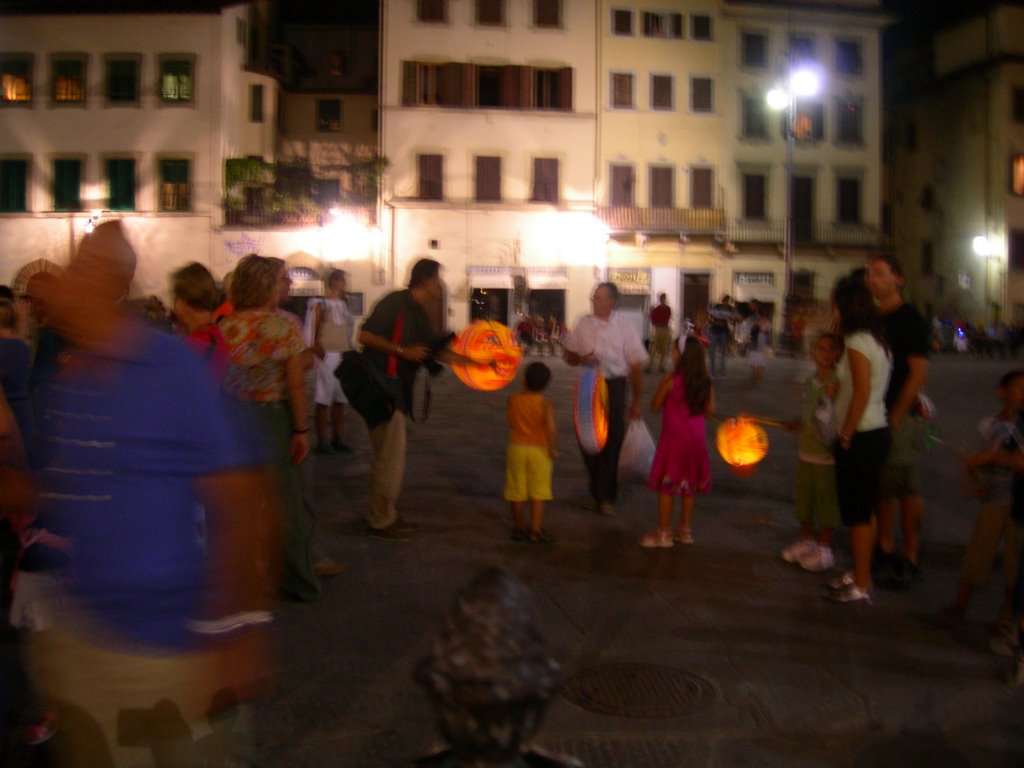
September 8 is the traditional day that Catholics celebrate the birth of Mary, the mother of Jesus. During the time of the Renaissance, pilgrims would gather on the eve of the holiday with lanterns in front of the Church of the Most Holy Annunciation (Santissima Annunziata). Today, it is mostly a family holiday, known as Rificolona. The crowd gathers in front of Santa Croce. Most of the children carry paper lanterns, lit with candles, on long sticks. They can be bought from many stores around the city, or handmade. There were stars, suns, animals, and even one in the shape of a castle. The rest of the children carried pea shooters and plenty of ammunition in the form of play-doh.

Anna, Matt, Lauren, and I went to join in the fun. Lauren made a lantern out of cardboard, and we joined the procession. From Santa Croce, the brightly lit crowd paraded through the streets of downtown Florence over to Santissima Annuziata. There, various dignataries gave speeches, and a children's choir sang several songs. Several trailers were set up along the back selling drinks and snacks. As we all milled about, listening to the program and meeting acquaintances, the pea shooters came out. It is also traditional to try to shoot each other's lanterns to smitherines. You are a great pea-shooter if you can get one to catch fire.

Anyhow, it was fun to get out and participate in one of the local holidays. I've been meaning to write about it all week, but I kept waiting until I had a better picture. I still don't have a great one--my camera's batteries were dying, and the light was awful--but I will go ahead and post. Anna took pictures, too, and maybe some of hers will come out better. If so, I'll add a better picture later.

The crowd begins to gather...

Domenica (Sunday)

Monday, September 04, 2006

Well, yesterday was my first day worshipping with the Florence church. A lot of the members were just coming back from vacation. In Italy, everyone vacations in August--many businesses and restaurants even close in the cities, while everyone is at the beach or the mountains. By next week, the building will be quite full with everyone back in town, and many of the students with Harding University's overseas program here will also be worshipping with us for the semester.

The church just got new songbooks. With so few non-Catholic churches in Italy, a new Italian-language song book is a major event. The last ones they had were falling apart; when a song was announced, everyone had to flip through a few books to try and find one that still contained that page. In class, we sang and discussed several songs (well, I'm assuming we were discussing the songs; we could have been discussing socks in between bursts of singing for all I would notice with my Italian...). One of the men in class, Luigi Giardino, was one of the translators who adapted many songs from English into Italian. After church, we had a fellowship meal. It's universal...there was a plate of chicken legs at the end of the table. I enjoyed meeting many of the church members while we ate.

On Sunday night, we (AI workers) held an English devotional at Pepperdine University's study-abroad building in Florence. The Pepperdine students won't be in until later this week, but the devotionals go on even in the summer so that any American travelers will have a place to go. We were happy to have four girls, all members of the church, who are spending a semester abroad on their own studying at an Italian university. They found the Florence Church on the internet, and came Sunday morning. They were very excited to find Christians they could spend time with in Italy. We invited them to the Pepperdine devotional, and they plan to be with us at both services for the rest of the semester. When we arrived at the Pepperdine building, two more girls were waiting who had also found us on the internet when they searched for English-language services. They normally attend a community church in that states, but they hope to be with us at that devotional again. Hopefully, we can be an encouragement to all of these girls.

First few days in Italy

Friday, September 01, 2006

Ciao! Well, I am finally here in Italy! It still doesn't seem real that I'm actually here now, after talking about it for so long. I flew out on August 28th, and arrived at the Florence airport 24 hours later (less seven hours time difference) at 6:00 pm on August 29th. Gary Williams, the director, and the rest of the AI workers--Matt and Lauren Freel, David Hopper, Kelly Fann, and Greg Seiders--were there to meet me. Anna Madox is also an AI worker, but she was out of town. That night, I went out for pizza with the rest of the workers at one of their favorite places. We stopped for gelato on the way back. If you have never had Italian gelatto (ice cream), you don't know what you're missing!

Wednesday morning, I learned how to do "pubblicita`" (I can't get the accent right on an English keyboard, and I can't find the thing to switch it at the moment...). Most Wednesdays, the group takes a different part of town and stuffs mailboxes (this is legal here) with flyers for the school, offering English/Bible lessons.

Thursday, Lauren took me to the Questura (police headquarters) in Florence to register for my permisso di sigiorno (permission for sojourn). All foreigners who plan to live in Italy long-term must register. We had to wait in quite a long line, but there were no problems and I was able to turn in my paperwork. That night, our directors, Gary and Jennifer Williams, took me out to dinner to get to know me. Mario, a long-time church member here who is currently staying at the school, and Brandon Marshall, a former AI worker who spent several years in the south of Italy who is visiting from the states, ended up going along, too, as we ran into them as we were leaving and they had already decided to go to the same restaurant. More pizza--good thing I like it! After dinner, Mario took us to his favorite gelateria (ice cream place), run by a childhood friend of his brother. They had cinnamon gelatto, which was very good. They tend to have a wide variety of flavors here--from the expected chocolate, strawberry, mint, and such, to melon, fig, blackberry, rice, nutella, lemon, and more. I have heard of such things as fish or ham-and-cheese.

Today, David took me back into town to sign up for language school. I will start Monday. I am looking forward to getting started. The language school is just a block away from the duomo, the famous cathedral in Florence. It's amazing to think of walking past that beautiful marble building every day. The people at the school seemed very nice, and I took a placement test to see what class I should be put in.

I am finally beginning to get over the jet-lag from the time difference. I was so sleepy the first couple of days. I am beginning to learn my way around--I know how to get to the bancomat (atm) and to the bus stop, and I know what buses to take to get into Florence. I am looking forward to meeting with the church on Sunday. I am beginning to settle in. The Bible School is in a quiet neighborhood, across the street from a park, in the suburb of Scandicci. Across the park is a hospital and an old castle, the Torre Galli (tower of the Galli family).

Well, I hope that you are all doing well. Feel free to e-mail me or leave comments on this site. I will let you know how language school goes next week...

A little more about training...

Hello again! I wanted to let you all know a little more about the training we did in Searcy in August. Here is a list of the classes we had:

Group dynamics, Dr. Carl Mitchell
English Using the Bible, Ryan Butterfield
Catholic Doctrine, Howard Bybee
Overview of Church History, Dr. Don Shackelfrod
The Holy Spirit and Miracles, Keith Cronk
Faith and Evidence, Dr. Don England
Romans, Dr. Warden
The Gospel and Post-Modernism, Bruce McClarty
The New Testament Church, L.V. Pfeifer
Evangelism, Noel Whitlock
Eastern Religions, Oneal Tankersley
Children's Classes, Dan and Suzanne Reed
Singing (we learned several songs in Italian), Joli Love
Sharing Evangelistic Experiences, Carla Lowe and Brandon Edwards
Cross-Cultural Communication, Dr. Howard Norton

On the Saturday we were there, we went out to Wyldewood camp and did a ropes course. Well, some of the group did a ropes course...those of you who know me now khow unathletic I am. I never actually made it to the rope...I am not a good pole-climber. :) Oh, well.

Altogether, it was a good two weeks with a lot of information to soak in. Many of our teachers had been missionaries in Italy themselves, and it was wonderful to hear their stories and experiences. Our group got along well, and although I am the only one going now, I look forward to working with Andrea, Brandon, and Kristin when they come in January.

Training!

Sunday, August 20, 2006

Hello again! I just returned yesterday from two weeks of training in Searcy, Arkansas. One of the most interesting parts of the training was getting to know and spend time with some of the missionaries who went to Italy right after World War II. These men and women are now active in teaching and sending us, the next generation of workers. The stories of these early missionaries are amazing. When they went in to Italy in the late 1940s and early 1950s, the country was still reeling from the war, and was staunchly Catholic. Teaching about a non-Catholic church was still illegal, and even after the constitution was changed to make it legal, was highly unpopular. Several were arrested, threatened, or thrown out of the country. Following is a history of the work in Italy, © Dr. Carl Mitchell, 1999:

The Italian Story

At the height of WWII, Harold Paden, sergeant, bazooka specialist, and ski trooper, in the 10th Mountain Division, was fighting the Axis; Alpine Mountain troops in the Italian Apennines between Florence and bologna. In the terrible winter of 1943-44, in a decisive battle in which one in seven of his division was killed, and 60 percent (including Harold) were wounded, defeating the enemy and survival were on Harold’s mind. At the same time, the seed was planted which led him to spearhead the historic evangelistic effort which occurred in Italy after the war.

Harold says, “The idea of my doing mission work in post-war Italy was born with God and my Christian upbringing. My Godly parents had more to do with my prepping than I did. It took time and the experiences of WWII for god to get my attention and make me understand His need for me in Italy. The decision came to fruition after another war was fought with Satan, in a long battle with my conscience. No sudden impulse! No foxhole faith! Lots of evaluation, introspection and sleepless nights of prayer! The battle no less intense! Casualties would be just as great! Lives would be sacrificed! God inspired a hard choice that I had to make. My dilemma: Who would go teach the Italians? Shall I send, or shall I go? Would this heavenly vision change the course of my life and career? Finally, one morning at 4 am I awakened my parents to join me in prayer! The Galilean had won!”

The immediate effect of Harold’s decision was the recruiting of his older brother Cline who, farther along in his education at Abilene Christian than Harold was at Pepperdine, was able to give attention to the preparatory phases of the Italian work.

The Crescent Hill Church of Christ in Brownfield, TX, agreed to support Cline, and became the focal point for the evangelistic thrust into Italy. In November of 1947, Cline and former classmate at Abilene, Bill Hatcher, sailed to Europe for a fifteen day survey trip of Italy. Passing through Switzerland, they were joined by Otis Gatewood, and by Maurice Hall who furnished his car. While visiting major Italian cities, they were struck by the spiritual darkness in which the people lived, by the poverty in evidence everywhere, and by the large number of destitute children that roamed the streets. They returned home with a mission!

Paden and Hatcher immediately began traveling among churches reporting on needs they had observed in Italy, recruiting workers, and raising funds to establish a beachhead in or near their target area of Rome. The Crescent Hill church decided to sponsor the founding of a home for Italian street children, and preparation were made to respond to the need of clothing and food that had been observed in Italy.

In March of 1948 a Lectureship was held in Brownfield, TX, to announce that churches of Christ were preparing for a spiritual invasion if Italy. In August of 1948, the Gordon Linscotts (supported by the church in Lewiston, Idaho) left for Italy to do advance work before the arrival of the larger group. Gordon, who had served behind enemy lines in Italy during the war, knew Italy well and was fluent in the language.

Meanwhile, steps were being taken to obtain visas for those who were to begin the work of the church in Italy. No doubt by Divine providence, the Italian Consulate in New Orleans misinterpreted a communiqué from Rome which announced that U.S. citizens no longer needed visas to enter Italy. Although the communication was intended to be applied only to tourists or casual visitors, the Consulate understood it to apply to all Americans regardless of their purpose. As a result, he informed the missionary group that they were free to go to Italy and that visas were not required.

A small mission task force arrived in Frascati, Italy on January 15, 1949 joining Gordon and Peggy Linscott. Members of the group and their sponsoring churches were: Cline and Jo Paden (Crescent Hill Church in Brownfield, TX), Harold and Bettye Paden (East Side Church in Lubbock, TX), Jack and Rosetta McPherson (Nacona, TX), Wyndal Hudson (Seagraves, TX), Bill and Peggy Hatcher (Hayes Avenue Church in Detroit, MI), Dale and Tillie Pittman (North Beach Church in Corpus Christi, TX), and Joe Chisholm (and elder of the Crescent Hill Church in Brownfield, TX). This group occupied property located by the Linscotts, including a 6500 sq. ft. war-scarred but otherwise beautiful villa, and a gatehouse containing two apartments. The property was located about twelve miles SE of Rome, on a hillside overlooking the city of Frascati.

Once settled, the group began distributing vast amounts of clothing which ahs arrive from the U.S., and, in cooperation with the Red Cross, placed about thirty orphans in the larger villa now named Villa Speranza (the house of hope). This former headquarters of the German High Command was brought under the command of the Lord for His work. Many Italians gathered to learn where these “angels of mercy” came from and what they stood for. Bible studies were begun through interpreters. By the end of January more than 300 were in attendance at these studies. The first baptisms began to occur in March and by June there were more than 50 members in the Frascati Church.

Imagine the surprise of the Italian government when it learned that a very evangelistic group has invaded the country armed with a letter from the Italian Consulate in New Orleans, giving them permission to work in Italy.

The obvious solution would have been to expel them, but it was not that simple. Guided by the Allied occupation forces, a constitution has been passed in 1946 which granted freedom of religion in Italy. In addition, Italy was in the process of being rebuilt with aid from the Marshall Plan. Efforts to dislodge these unwanted guests took more indirect forms.

First, a challenge was given to the missionaries to engage officials of the Catholic Church in formal debate. Capuchin monks engaged Cline Paden in five debates on principal Catholic doctrines. As many as 400 attended these discussions and public favor indicated a great victory for the Truth! Many members were added to the church of Christ as a result. Such public debates have never occurred again in Italy!

Second, an effort was made to drive out the workers through threats and intimidation. Word was circulated that those who were baptized were paid large sums of money. Communist papers said the Americans were spies working under the direction of Senator Connelly. Government papers claimed the workers were communists who were sent to strengthen the communist party. This claim was also officially made by high Italian offices to our State Department and believed. One newspaper said that while the group was on vacation in Italy, it had decided to live in the beautiful Roman hills and used religion as an excuse to do so. Some warned parents not to allow their children to be preyed upon by the missionaries, and ordered that anyone receiving a Protestant Bible must turn it in at the local parish church. The end result was that almost overnight, virtually everyone in Italy knew of the presence of this mysterious sect, and many wanted to know more!

Personal threats of bodily harm and even death were issued by a militant group called Catholic Action. Crowds marched in front of the workers’ place of residence calling for their death. The brakes were found cut on a jeep used by orphanage personnel. Workers directed toward a bible study in Castel Gondolfo were met by a large group and forced to turn back, leaving under a barrage of stones. Wyndal Hudson was warned a land mine had been planted where he parked his car when he went to the city of Rocca di Papa for a Bible study. He did not go, and a passing boy was seriously injured by this device.

This second approach caught the attention of our press, and an article with pictures was run in Life magazine, Feb. 20, 1950. This of course aroused great interest and support in America. In Italy, what was intended to be Adverse publicity resulted in thousand of letters asking for additional information. One of the workers discovered that a Jack McPherson club had been established in his honor in the Venice area. The flood of letters led to the creation of a national Bible correspondence course resulting in thousands of students, hundreds of baptisms, and numerous congregations. In a short period, a small beachhead in Frascati developed into scores of churches which dotted the nation.

A third prong of government response, occurring in 1952, involved building closures. In an attempt to destroy the church, police began denying member access to places of meeting, actually posting police at the entries. Though this only occurred in Alessandria, Livorno, Florence, and Rome, Italian officials said all building occupied by churches of Christ would be closed. Howard Bybee, Lido Petrini (former priest), and Salvatore Puliga were arrested for preaching the gospel. Carl Mitchell was issued a threat of arrest for teaching English as a means of converting Italians, and eventually Cline Paden was expelled from Italy.

Building closure has been an abusive tactic long used against Protestant bodies in Italy. When Mussolini signed the Lateran Pact with the Catholic Church in 1929, Catholicism became the religion of the State, and laws were established which made life difficult for non-Catholic churches already in existence, and made it virtually impossible for a new church to begin. When the constitution giving freedom of religion was passed, it provided for the establishment of a court which would have the task of bringing all existing laws into line with the constitution. For reasons that are certainly suspect, years passed without this court being appointed. As a result, police were free to close down non-Catholic church buildings for a variety of excuses. By lengthy, costly legal process, police actions were declared illegal, but only after a local church had suffered greatly.

Finally, in May 1957, a group of Italian missionaries including Cline Paden, Harold Paden, Gerald Paden, Howard Bybee, Carl Mitchell, Mel Pownall and Hillard Story went to Washington, D.C. A cadre of our most influential congressmen and senators was assembled to discuss the history of harassment suffered by churches of Christ in Italy. It was also demonstrated to this group that Italy was in fact violating a treaty signed by Italy and the U.S. guaranteeing reciprocity of treatment of guest nationals from these two countries. Then a delegation of senators and congressmen accompanied the missionaries to meet with State Department officials. John Johnson [a member of the church], chief legal counsel of the Air Force, argued the Church’s case successfully despite the opposition of State Department lawyers. The State Department immediately issued a formal protest to the Italian Government, thus beginning the process by which most of the legal problems of churches of Christ in Italy were positively resolved.

One legal problem still plagues us! Italian law for church recognition requires that a person be appointed as the official representative of the church for all of Italy. A review of this situation as it related to other churches showed that this person tended to become, in a certain sense, the head of the church. Our refusal to agree to this condition leaves us in a kind of “non man’s land among churches in Italy. While we are tolerated and allowed to do our work as a church, we are not recognized as a church. This results in our not having certain rights that are made available to other non-catholic bodies: our ministers are not exempted from military service, we cannot officially perform weddings, as a church we cannot own property, and we do not enjoy tax benefits given to other churches.

WHY CHURCHES GROW
Biblical and secular histories attest that the church grows best in times of persecution. Such has been the case in Italy! From its small beginning in Frascati, this group without funds for advertising saw their work advertised throughout Italy by the opposition. As the interest thus spurred was followed up and developed, within a short time the length and breadth of the nation was populated by almost sixty congregations, with a t least 1500 members. Among its members were included former monks, nuns, and priests. Some who had been leaders in the Catholic church became dynamic evangelists, including Fausto Salvoni, Italo Ministroni, Mario Piccoli, Lido Petrini, Raffaello Paone, Aurelio Nori, and Luigi Pandini.

Eventually 31 boys were enrolled at the home and given an opportunity to prepare for life. Though there were legal snarls which space does not permit narrating, this work must be considered most successful! Boys, many of which were literally taken off the streets, were supported through completion of the vocation preparation they had chosen, and are now scattered throughout Italy. Examples of the home’s products would be Gianfranco Sciotti, a church leader in Florence and a successful businessman, and Claudio Chisholm, who for many years did missionary work in Italy, before settling in the Brownfield, Texas area. In 1956, changing economic condition in Italy influenced a decision by the elders of the church in Brownfield, TX, not to accept additional boys into the home.

BIBLE TRAINING SCHOOLS

From the beginning of the Italian work, emphasis was placed on training men and women for Christian service. A school was held in Frascati (1950-1952) with persons from as far away as Sicily in attendance. Outstanding evangelists produced from this effort included Alessandro Corazza, Salvatore Puliga, Rodolfo Berdini, Franco Coco, and Antonio Buta. A second school in Milan (1953-1957) produced many faithful preachers including Leoluca Bonanno, Luigi Lisi, Gilberto Di Luca, Otello Pandolfini, Lidio Petrini, and others. A school in Florence (1958-1981) devised to produce self-supporting church workers sent many highly trained young people back to their congregations where they still serve.

CHANGING CURRENTS

After a highly productive beginning, the Italian work has not been able to maintain its high level of growth. Two factors seem to be major reasons for a more difficult working situation. The first is the work of Pope John XXIII in Vatican II (1963-1965). In section 90, called “The Role of Christians in International Institutions,” there is a call fro cooperation between the Catholic Church and the “separated brothers” who also profess the gospel. In section 3 of “Catholic Principles on Ecumenism,” it is stated that these “separated brothers” are to be accepted with love and respect. Section 4, on the same topic, admits that other believers both participate in salvation and bring others to salvation.[1]

When Catholics in Italy were warned to have nothing to do with “these heretics bound for hell,” interest was aroused and many wanted to know more about churches of Christ. Later when Italians were told that we were separated brethren, and it made no eternal difference as to which camp one occupied, the public attitude came to be, “then why bother!”

A second negative force affecting the Italian work has been the rapid economic development of the Italian people. When our work began, Italy was suffering the aftermath of WWII. Work opportunities were scarce, and poverty was rife. It seems universally true that poverty tends to create a more receptive soil for the gospel seed. However, Italy has enjoyed such success financially, that it now ranks fifth in world economies. It seems universally true that financial wellbeing tends to create spiritually unproductive soil. As a result, today it is about as hard to make a convert in Italy as it is in the United States.

ENCOURAGING SIGNS

As we begin our second half-century in Italy, those of us who love Italy and are involved in the work of the church there are encouraged as we look to the future. Some of the new generation which has grown up with economic wellbeing seem to understand that material things cannot fill one’s spiritual need. Consequently, there is a resurgence of interest in spiritual things in Italy, especially among young people. One of our best projects in called Avanti Italia (go ahead Italy), usually shortened to A.I. This is a program which is especially effective in reaching young people. A.I. was begun by Howard and Doris Bybee, and is sponsored by the College Church in Searcy, AR. It involves sending recent college graduates to Florence for two years of apprentice mission work at subsistence income.

These young people live together in a large villa owned by the church. On-site directors are Jay and Alicia Walls [this article was written in 1999; the current directors are Gary and Jennifer Williams]. A.I. workers are there to serve in the mission of the church in any way needed. However, most of their time is spent teaching English using a modern English Bible as a text. Virtually all conversions in Florence in the past fifteen years have come through this program. The number of young people wanting to be a part of A.I. has grown to the point that we are now sending some of them to work with other congregations. A.I. has also proved to be a good way to develop long-term workers. At present, eleven former A.I. participants have returned (or remained) to work long-term.

Other important indicators of success are the many congregations in Italy which support their own work financially, and do all of their own teaching, preaching, and evangelizing. Some are supporting their own local ministers financially. Some are supporting mission work financially in other parts of Italy. Some of the churches in the South of Italy are involved in missionary outreach to Albania. Some members who work in the medical field participate in medical campaigns to Africa. Hundreds of faithful brothers and sisters in Christ have died in the Lord. Many have suffered greatly because of the stand they have taken for Christ.

What is the future of the work in Italy? Almost two hundred years ago a missionary in Burma, while in prison there, was asked this same questions. He answered, “The future of the church in Burma is as bright as the promises of God.” What a good answer! That is true in Italy as well!

[1] The Documents of Vatican II, (All Sixteen Official Texts Promulgated by the Ecumenical Council, 1963-1965, Translated from the Latin), W.M. Abbott, S.J., General Editor, American Press, Association Press; Western Publishing Company, Inc., 1966).
Ciao! Ciao, by the way, is hello and/or goodbye in Italian. Anyhow, hello, and welcome to the site! I hope this will be a good way for my friends and supporters to be involved as much as possible on the work being done by the Avanti Italia team in Italy. This is my online journal; in it I will write about my experiences and challenges on the field, and let you all know of prayer requests. We have a website, http://www.avantiitalia.org/, that you might want to check out. It's currently being redesigned, so more things will be added along.

I've had several people ask about our address there. The Bible school address is:

Scuola Biblica di Firenze
Via Armando Spadini, 24
50018 Scandicci (FI)
Italy

My e-mail is kacross@gmail.com; feel free to contact me if you have any questions about our work or this site.

Arrividerci! (See you soon!)

Florence and the Arno River, early morning

Thursday, August 17, 2006

Farewell Trip to Cologne

Friday, October 22, 2004

It's an absolutely beautiful fall day.  The sky is a bright blue; there's only a few little wispy clouds.  The trees are changing colors and everything's sparkling in the bright sunshine.  After returning from hazy, dusty, rocky Greece, everything looks so green and alive here. 

I'm on a train headed for Köln.  It's wonderful to get the chance to take this little trip on my own, the way I've been planning.  I was upset when it didn't work out yesterday, but Adam was with me then so it's for the best since I get to be alone today.  It's just hard to really get the experience of Europe when I'm with a crowd and I feel like I have to keep up conversation.

On the train from Verviers to Aachen I was thinking about the first time I took that train, the first time I saw Germany  I tried so hard to catch all the little differences.

Germany is a beautiful place.  It's fairly flat in this part here, as I'm moving away from the Ardennes. Every now and then I see a few of the white, spare-looking windmills on a  ridge or windy spot.  I enjoy the train between Verviers and Aachen because it goes through rolling green farmland, with the black and white cows scattered around, and occasionally sheep.  The landscape's not so different here; it's mostly the buildings.  Nearly everything has a red clay tile roof, and in the towns all the buildings are built together in their little rows with no space between.

I'm glad I'm getting to go on this trip today.  It sounds silly, but I feel like I need to say goodbye somehow to the cathedral.  It represents all of what I came to Europe to find.  I nearly cried that first day I saw it (August 19th, I still remember, on the way to the Rhine River).  I never got a poster of it, and that's what I want today.  I want to be able to see it every day.  I don't want to think about the idea of never seeing it again.

It looks like they've been getting all the rocks out of the fields, or maybe that's potatoes--no, more likely rocks.  There's a big pile next to most of the fields. I've never noticed that before, so it must be something they do this time of year as harvest is finishing up.

What a beautiful day.  I love days like this.  I feel like I look just a little more European today, too.  If you only saw me from the waist up, anyhow.  My too-big jeans and Sketchers don't help.  But, I'm wearing my gray leather fake leather bomber jacket I got in Rome, and my white scarf.  Nicole fixed it like the women in Verviers wear theirs (and most do wear one), looped through itself with the ends tucked into my jacket.  I really don't need a scarf on the train, but I don't want to take it off because I know I probably wouldn't be able to fix it back the same, and I want to blend in a bit in Cologne.

I want to get my mother a t-shirt somewhere; maybe I'll find one here.  She would like that, from my favorite place.

Now I am here.  I"m sitting in a pew in the Cologne Cathedral, enjoying the grandeur of the place.  The inside isn't the most breath-taking place I've seen, but it's still beautiful: the massive stone pillars and the arches, the white vaulted ceiling, the statues.  This time the apse was open and I walked around there, to get a closer view of the famous crucifix, made in about the eleventh, or maybe tenth, century, if I remember right, and the first one to show Christ with his eyes closed on the cross.  I also got closer to the golden box, now protected by glass, which holds the relic of the bones of the magi.  I love stained glass.  I stood for a while and looked at the stories told in it--the one to my right, lit up by the sun, is of the apostles with tongues of fire on their heads when they received the Holy Spirit.

I lit a candle as I came in. I lit one in Westminster, too.  I like knowing that i have left some glow here, a little bit of light, to do more than just silently walk around and leave no mark.

Well, now I'm in Köln Hoptbahnhof, waiting for my train to go home.  I have a few minutes, so I thought I'd stop and write for a minute.  I enjoyed my time today.  I took a lot of pictures. I got two posters: one a color photo of the cathedral and the city; the other a really interesting one with the shape of the cathedral written in musical notes, in an "Ode to Cologne".  I didn't find any t-shirts for mom.  I didn't see many at all, and what I did see I didn't like.  Cologne is a pretty city, but the t-shirts are ugly.  I'll get her one somewhere in Belgium.

Well, now I'm in Aachen.  It's nearly five; a train for Verviers doesn't leave until six.  Or 18:00--it's taken a  long to time to start getting used to twenty-four-hour time.  I have plenty of time, so I walked down here to this little park right across from the old gate tower.  I can smell the falling leaves.

Well, some guy just came up and looked over my shoulder and said something in German.  I just smiled and closed the book a little and he said, "Okay," and something else in German and went on.  I hope he's not offended.  I'm not rebuffing him; I just don't understand German.  And it's not really a good idea to let him know that when I'm alone anyhow.   


Antwerp, or McDonald'sville

Thursday, October 21, 2004

Well, I woke up to an absolutely beautiful fall day--sunny and crisp.  I made plans to take the last trip to Cologne, which I'd been planning for some time.  I had planned to go alone, but Adam said he'd go along with me.  Aaron was going to Aachen, so we planned to meet him on the train.

However, we missed the train by a couple of minutes.  I was so mad at myself.  I don't think I've ever missed one leaving Verviers before.  I was upset because I really wanted to make it to Cologne, and I hated leaving it to the last day.  What if it was cold and rainy tomorrow, and not good for pictures?  What if something came up?  Well, if it had been just me, I would have goofed around in Verviers for a couple of hours and caught the 14:13 train and just gotten back late, but Adam was with me and didn't want to do that.  He wanted to go to Antwerp, so we caught the 12:32 train for Liege.  I had rather have gone to Maastricht, but Antwerp was fine.  We were stupid and didn't realize that Anvers in French was Antwerp, so we took the long way around and went to Brussels and then on to Antwerp.  One there, we just walked around the main streets, went to a good used bookstore (of course--apparently we two can smell them out) we had heard of, and ate at one of the seven McDonald's on that street.  It was amazing, really--we would pass a McDonald's, and almost immediately see a banner attached to the lamp post saying "McDonald's--four minutes ahead!".  At some points, we could look in both directions and see a McDonald's.  And yet, they all seemed to have customers in them, even though they were only a five minute walk between them. And these aren't mini-McDonald's; they are regular, full-size ones.


The Antwerp train station was one of the most elaborately decorated ones that I've been through, and I've been through a lot of them by this point.   I don't think I'll ever get tired of the opulent old grandeur of so many public spaces in Europe. 

We took the train back directly to Liege, but it turned out the be a local train that stopped at every little town and wide spot in the road along the way.  We discovered a couple of Liege stops we'd never even heard of.   It took forever, but we finally made it.

When we got back, Dr. Taylor asked us what all we saw, and apparently we just missed the giant sculpture of a hand that is famous in Antwerp--it was just a little further along the road we were on.  And we could have went down to the port and looked around, but oh well.  This is why you should research, but we had a nice day the same. In the end, I'm glad we went, because I wouldn't have spent much time on Antwerp otherwise.